01
What should WhatsApp automation do for an Oman business?
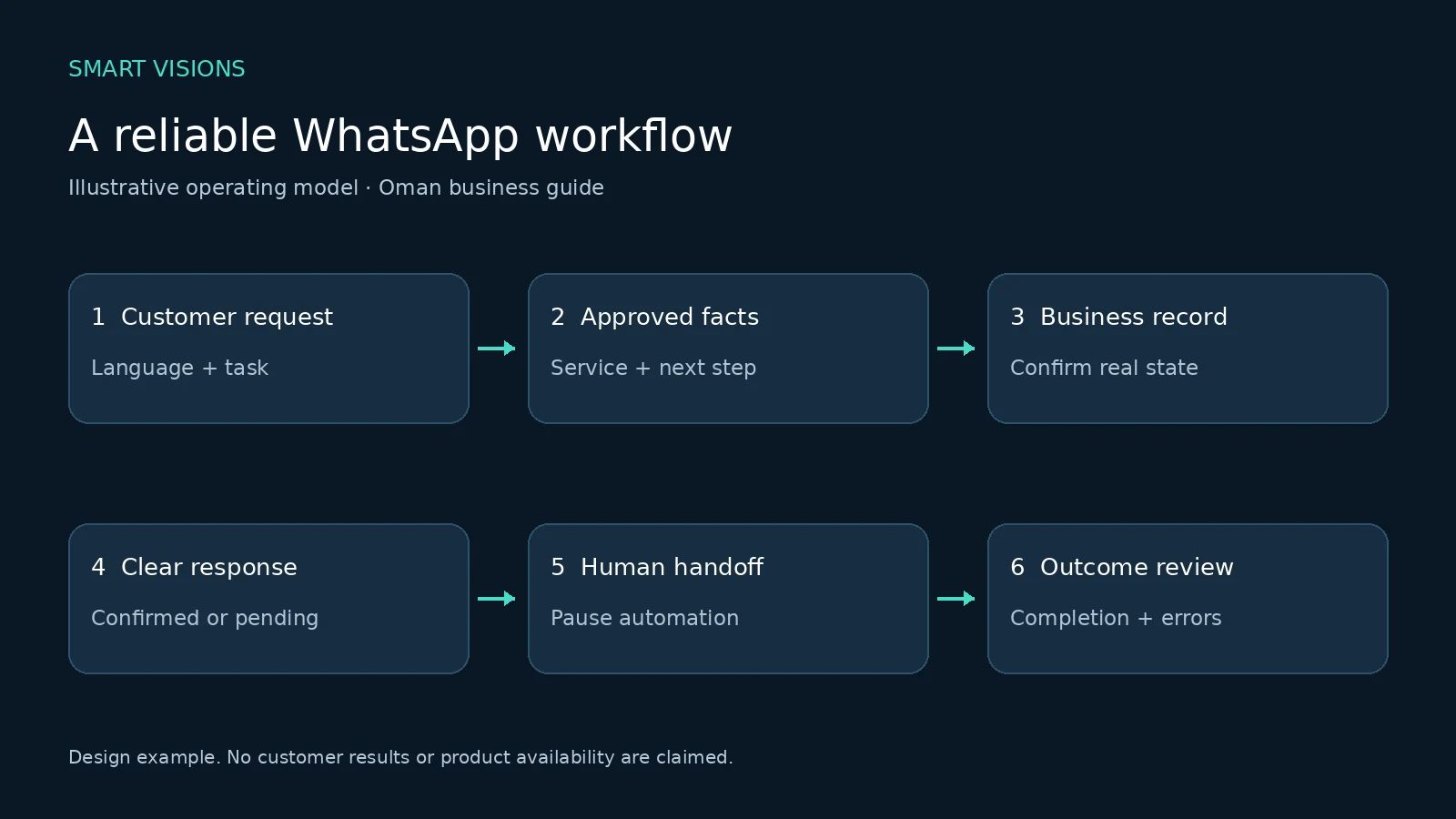
WhatsApp automation should help a customer complete a specific task: understand a service, request a quote, arrange a booking or reach the right person. Start with one repeatable task and connect it to the record that confirms the outcome. A fast reply is useful only when it is accurate and leads somewhere. This guide explains how to choose that first task, prepare English and Arabic responses, protect human control and assess whether the system actually helps. It is an implementation framework, not a promise of customer numbers, revenue or approval by a platform. For a business serving Muscat, a practical starting point might be quote intake for a home service, appointment requests for a salon or enquiries about a training course. These are illustrative examples, not Smart Visions client case studies. Each example needs a named staff owner, approved service information and a clear point where automation stops. If you are comparing implementation support, review our WhatsApp automation service in Oman alongside the operational questions below. Keep the commercial service page for evaluating support and use this guide for planning the workflow.
02
Choose a first workflow by observing real enquiries
Before buying software, review a small representative sample of recent enquiries that you are permitted to examine. Remove unnecessary personal details from the working notes. Record what each customer wanted, what staff needed to ask, where they looked for the answer and how the conversation ended. Include busy and quiet periods, English and Arabic requests and conversations that were abandoned. Do not select only easy examples that make automation look successful. Your sample is an operating baseline, not a statistically representative claim about the Oman market. Choose a task with repeatable inputs, a verifiable outcome and manageable consequences if something goes wrong. For quote intake, inputs might be service type, area and preferred contact time. The outcome is a complete request assigned to a person, not an automatically invented quotation. Give the workflow a success definition such as “the customer understands that a staff member must confirm scope and price.” Exclude tasks that depend on judgement you have not documented. A written one-page brief should identify the trigger, required information, approved response, staff owner, failure path and stop condition. If any of those is unclear, improve the brief before automating.
03
Decide whether the Business App or a platform integration is appropriate
A small team with a modest enquiry volume may be better served by improving its existing WhatsApp Business App process first. Consistent greetings, maintained business information and disciplined staff follow-up can solve a real problem without an integration project. A platform integration becomes more relevant when you need governed routing, multiple operators, confirmed business-system actions or a durable connection to a CRM. Compare the operational requirement, not the number of features in a sales presentation. Ask the supplier to demonstrate the exact task with your acceptance criteria. If keeping the existing phone app and number matters, make that a written onboarding requirement before authorising any account change. Ask the provider to verify the current supported connection mode, eligibility, app behaviour, history implications and recovery procedure for your actual account. Do not assume every account can use the same connection method. Do not delete an account or accept a destructive migration merely to complete a demonstration. This guide does not certify coexistence eligibility or any individual provider's readiness. Obtain a clear explanation of what will remain available on the phone, what will change and how a failed connection will be handled before proceeding.
04
Write the operating brief before designing messages
Describe the customer task in plain language: “capture the information needed for a staff member to prepare a quote.” Then define what the assistant may and may not do. It may explain published services, ask agreed questions and route a complete request. It may not negotiate a discount, confirm an unavailable appointment or promise that a manager will reply within an unstaffed period. The difference should appear in the workflow configuration and the staff instructions, not only in a project proposal. Establish a named business owner who can approve changes to those boundaries. Use a short state list that staff can understand: new enquiry, information requested, ready for staff, human active, completed and closed without completion. Define the events that move a conversation between states. A new customer message is an event; an assumption that someone “probably booked” is not. For each state, write the permitted automated action and its stop rule. When several tools are involved, nominate one record as the source of truth. Keep a versioned copy of the brief and record who approved it. Changes to service scope or opening hours should trigger review of the relevant messages before those messages are sent again.
05
Prepare a small, maintained knowledge set
Build the first knowledge set from approved business information: service names, areas served, opening hours, enquiry requirements, preparation instructions and contact routes. For a Muscat service business, area information should reflect actual coverage rather than a list of neighbourhood keywords. If you do not cover a requested area, the assistant should say that staff need to check. Keep changing information such as availability or individual quotations out of general explanatory text. Those answers need the system or person that can confirm the current position. Assign an owner and review date to every knowledge group. Record the approved answer, the underlying source and the situations where the answer is insufficient. A simple service catalogue can be enough at first; it must be maintained. Test what happens when a customer asks about a service that is absent, uses a local abbreviation or mentions an old promotion. The correct response is a clarification or handoff, not a confident invention. If a business fact has expired, disable the affected response until it is reviewed. Give staff a way to report an incorrect answer and trace it back to the knowledge version that produced it.
06
Design English and Arabic as separate customer experiences
English and Arabic workflows should share the same approved business facts while allowing their wording to differ. Ask a competent Arabic reviewer to check service terminology, courtesy, question order and the naturalness of short replies. Mechanical translation can produce an understandable sentence that still sounds awkward or asks the wrong operational question. Keep names, amounts, dates and locations intact when a customer changes language. For mixed-language messages, preserve the customer's wording where useful and ask which language they prefer if the intent remains unclear. Create a test set with the same business task expressed in different ways. Include an Arabic enquiry followed by an English location, a short voice-message transcription with missing context, a misspelled service name and a customer who answers several intake questions in one message. Test right-to-left display in any linked forms as well as in the conversation. Do not force a customer through an English form after offering Arabic assistance. Language detection should support service, not override a preference the customer already expressed. Before expanding to another GCC market, separately verify service coverage, local terminology and the actual customer journey; an Oman workflow is not automatically a regional operating model.
07
Build an intake flow that asks only useful questions
Good intake reduces repetition. Ask the question that changes the next action, explain why it is needed and avoid collecting information simply because the form allows it. A quote request might need a service category and approximate area before it needs a full address. A training enquiry might need the course and preferred schedule before it needs employer details. Make optional fields genuinely optional. If a customer has already supplied a detail, reuse it after checking its meaning instead of asking the same question again. Write a sample conversation before building the flow. For example: the customer asks about a service; the assistant identifies the task; it asks for the area and a short description; it summarises the request; the customer corrects one detail; the request is assigned to staff. Label this as a design example. Include a route for “I just want to speak to someone.” Keep the final summary short enough for the customer to inspect on a phone. Distinguish submitted from confirmed: “Your request is with our team” must not become “Your booking is confirmed” unless the authoritative booking record supports that statement.
08
Connect the website and CRM without duplicating leads
The website and WhatsApp should form one customer path. A visitor who reads a service page and opens WhatsApp should understand which enquiry they are starting. Use a relevant call to action and a concise suggested opening message. Do not encode sensitive personal information into a public link. If your website needs a clearer enquiry journey, our website development page for Oman explains the related service scope. The design task is to make the next action understandable, not to add more contact buttons everywhere. For CRM integration, define the minimum matching rules and the situation where a staff member must review a possible duplicate. A phone number can help match a conversation, but shared or changed numbers need care. Preserve the original enquiry source and the subsequent interaction rather than overwriting attribution with the latest channel. The CRM should own the lead and its commercial stage; the conversation system should own message delivery and human control. Write down which events may update the CRM and what happens when that update fails. Avoid allowing several workflows to create a fresh lead every time the same person sends a new message.
09
Confirm bookings and quotations from authoritative records
An assistant can gather a preferred time without being able to confirm it. The booking system or responsible staff member must establish actual availability. Separate requested, pending confirmation and confirmed states. Show the distinction to the customer in simple words. If two customers request the same appointment, the workflow should resolve the conflict against the booking record rather than promising the slot twice. For rescheduling, confirm which booking is being changed and prevent an old reminder from being sent after the time changes. Quotation workflows need equivalent care. Collecting scope is different from issuing a final price. If the business requires an inspection, a manager's approval or a supplier check, explain that dependency. Do not let a language model invent an amount from a similar past enquiry. After staff approve a quotation, store its version and the conditions that matter to the customer. If payment is required, use the business's approved payment route and confirmation process. A chat reply that says “paid” is not enough to reconcile a transaction. When an integration is unavailable, keep the request pending, notify the responsible person and tell the customer what will happen next.
10
Make human takeover visible and dependable
Human takeover should be a primary feature. Define triggers such as a direct request for a person, a complaint, unclear scope, a failed business-system action or a question outside approved knowledge. A handoff should include the customer's task, relevant collected details, the last answer and the reason for escalation. Staff should not have to read a long thread to discover what the automation already attempted. Give every escalated request an owner or a clearly staffed queue, with an agreed process for unassigned items. Once a staff member takes control, automated replies should pause for that conversation until an explicit rule releases control. Test the race where a human starts typing while an automated response is already queued. Define whether that response must be cancelled and how the cancellation is recorded. If the team is unavailable, use a truthful acknowledgement with the next available action; do not claim round-the-clock human service unless it exists. Check the handoff path on mobile because staff may use it away from a desk. A prominent “speak to our team” route helps customers who cannot or do not want to complete an automated flow.
11
Treat outbound messages as a separate controlled workflow
Meta's WhatsApp Business Messaging Policy, reviewed on 5 October 2026, requires recipient permission and respect for opt-out requests. Its platform rules distinguish the customer-service window from messages requiring approved templates. Check the current official policy before implementing any outbound journey. The source notes identify the policy used for this review. Approval of a template does not establish customer consent, prove delivery or guarantee that a campaign is appropriate for your audience. Do not use scraped numbers or treat an old enquiry as unlimited permission for promotional contact. Design follow-up around a specific requested purpose. A quote reminder should stop when the customer replies, declines, completes the action or asks not to be contacted. Record suppression centrally so another workflow cannot immediately send a different message to the same person. Separate service updates from promotional messaging and review frequency across the customer relationship, not only within one campaign. Give staff visibility into what was scheduled, what was sent and why a message was stopped. Use approved template content where required and keep variables under control. Any change in policy, category or eligibility should trigger revalidation before the affected workflow resumes.
12
Handle failures without sending duplicate messages
Plan for unavailable integrations, delayed responses and ambiguous delivery results. A timeout does not prove that an action failed; the receiving system may already have accepted it. Before retrying a booking creation or message send, check whether the original action has a durable reference. Give consequential actions a stable identifier so the workflow can recognise a repeated request. Keep accepted, delivered and completed states separate. A provider accepting a message request does not mean that the customer read it or finished the intended task. Write a recovery runbook with concrete decisions. If the CRM is unavailable, retain the intake request and assign recovery responsibility. If a booking response is ambiguous, reconcile against the booking record before promising a result. If a notification fails, avoid silently restarting the entire customer journey. Test a delayed webhook, repeated event and interrupted staff handoff. Ensure failures are visible to staff without exposing internal technical details to the customer. The customer needs a clear next step; the operator needs the event reference and recovery instructions. A manual pause control should stop new automated actions while preserving the information needed to investigate.
13
Use AI for language, with boundaries around business decisions
AI can help identify an enquiry's intent, summarise a thread and compose a response from maintained business information. Those tasks still need constraints. Decide which questions can be answered from approved knowledge and which require a live system lookup or staff review. A fluent answer is not evidence that a slot exists, a price is current or a service is available. Review the proposed response against its source before allowing it to make a consequential promise. Missing information should lead to a clarification, not a fabricated detail. Test instructions that try to change the assistant's role, request private customer information or bypass a handoff rule. Customer text is part of the enquiry, not permission to alter the business workflow. Limit the tools the assistant can invoke and validate their inputs independently. Start with suggestions or low-risk assistance if the business has not yet verified action execution. Expand only after you can inspect both successful and failed outcomes. Our AI automation page for Oman provides related service context; evaluating the service should include these operational boundaries, not just a persuasive demonstration of conversational fluency.
14
Measure completion rather than message volume
Choose a small baseline before launch. Useful measures include time to the first useful reply, intake completion, unresolved requests, correct handoffs and confirmed outcomes. Define each denominator. For intake completion, count eligible conversations that produced the required request details, not every message received. For a confirmed booking measure, use the booking record rather than a keyword such as “booked” in a chat. Record the date range and any excluded test traffic. Avoid comparing a busy seasonal week with an unrelated quiet period and calling the difference an automation result. Track errors alongside efficiency: duplicate messages, incorrect facts, failed actions, customers repeating information and requests for human help that were not honoured. Review English and Arabic results separately when the sample supports it. A higher handoff rate can be healthy if the assistant correctly recognises complex work. A high automation rate can be unhealthy if conversations close without completion. Lead quality should come from the business's agreed qualification criteria. Do not present enquiries as customers or platform interactions as revenue. With small volumes, use individual conversation reviews and describe uncertainty instead of displaying an impressive percentage from a handful of events.
15
Estimate costs by separating implementation and ongoing operation
Ask for a written cost breakdown. Implementation may include workflow design, content preparation, bilingual review, integrations, test cases and training. Ongoing costs may include the software subscription, messaging charges, AI usage, maintenance and staff time. The relevant total depends on the actual scope and current supplier terms. This guide does not quote a universal price for Oman or claim a guaranteed return. Check platform pricing directly and ask which costs are passed through, marked up, limited or charged as overages. Use a simple scenario based on your own observations. Estimate eligible enquiries, the proportion that need automation, the number of follow-up actions and the staff time still required. Compare that with the baseline time spent on the same tasks. Include maintenance and error recovery, not only the best-case time saved. Ask what happens when usage exceeds the allowance, who owns the number and records, and how data can be exported. A cheaper subscription can become an expensive operating model if staff must reconcile duplicate records daily. A larger project is not automatically better either; begin with the smallest scope that can produce a verifiable improvement.
16
Run acceptance tests before inviting real customers
Create a written test set around the workflow brief. Cover a normal request, an incomplete request, a change of language, a correction, a duplicate event, an unavailable integration, a customer asking for a person and an opt-out. Use authorised test participants and clearly marked test data. Do not manufacture customer testimonials or treat test bookings as business results. For each test, record the expected message, record change, staff notification and final state. The acceptance result should be reproducible by someone who did not build the workflow. Test the whole customer path on a phone: service page, WhatsApp entry, intake, handoff and confirmation. Check that links reach the intended production destination and that Arabic forms display correctly. Confirm that a human can pause automation and recover an unresolved request. Start with a controlled pilot and inspect every consequential action during that period. Set stop conditions before launch, such as an incorrect commercial promise or a duplicate confirmed booking. A staged release is useful because it exposes operating problems while staff can still manage the volume; it is not a substitute for testing obvious failure cases beforehand.
17
Compare providers with a concrete demonstration brief
Give each provider the same sample task and ask it to show what happens at every boundary. Who owns the business number? How is a customer matched to a CRM record? What changes on the phone? Where does approved knowledge live? How does a person take control? What happens when the booking system times out? Ask for evidence from a controlled test of the proposed setup, rather than unrelated claims about other customers. Separate generally available features from account-dependent options and work that still needs configuration. Assess maintainability as well as the initial demonstration. A business owner should know how to update service information, inspect failures and request a change without rebuilding the whole system. Ask for permissions, audit history, export options and a handover document. Clarify what support covers and which external platform approvals remain outside the provider's control. Do not accept a guarantee of account eligibility, message delivery or commercial growth where those outcomes depend on external decisions or customer behaviour. The strongest proposal explains scope, boundaries, responsibilities and acceptance criteria in language your team can use after the salesperson leaves.
18
A practical first-month plan and your next step
In the first week, inspect existing enquiries, choose one task and agree on its operating brief. In the second, prepare the approved facts, English and Arabic wording, staff ownership and intake flow. In the third, connect the necessary business record and run the acceptance tests, including failure and takeover cases. In the fourth, run a controlled pilot, review outcomes and decide whether to improve or expand. This is an illustrative sequence, not a delivery-time promise; dependencies and approvals can change the schedule. Your next step is to write the one-page workflow brief and gather the information it requires. Bring your actual service scope, areas covered, enquiry examples, current tools and requirement to preserve the phone app if that matters. Do not share unnecessary customer details for an initial assessment. Smart Visions can discuss the intended workflow and implementation scope through our contact page. Ask for a proposal that identifies the first verified customer task, what remains human-managed and how success will be measured. A useful WhatsApp system gives customers a clear next step and staff a dependable record of what happened. That is the basis for improvement; publishing a chatbot or sending more messages is only an activity.
FAQ
Questions this page should answer
Practical answers based on the scope, evidence and implementation context covered above.
What is a sensible first WhatsApp automation task for an Oman business?
Choose a repeatable task with a verifiable outcome, such as collecting quote-request details for staff review. Write the trigger, required information, owner, failure path and stop condition before building it.
Can I keep WhatsApp Business on my phone when connecting automation?
Make preserving the phone app and number a written requirement. Ask the provider to verify the currently supported connection mode and eligibility for your actual account. This guide does not guarantee coexistence; do not accept a destructive migration simply to complete a demo.
How should English and Arabic enquiries be handled?
Maintain the same approved business facts in both languages, but review wording independently. Test language switching, names, dates, places and the linked forms. Respect the customer’s language preference and hand off unclear requests.
When should an automated WhatsApp conversation move to a person?
Hand off when the customer asks, the request needs judgement, information is missing or a business-system action fails. Include the task and collected context, assign an owner and pause automated replies while a person is active.
What should I measure before expanding the workflow?
Measure completion of eligible tasks, unresolved requests, correct human handoffs and confirmed business outcomes against a defined baseline. Also review duplicate messages, incorrect answers and failed actions. Do not count messages or enquiries as revenue.
Smart Visions
Turn the strategy into a working system
Smart Visions designs and implements the websites, AI, automation and growth infrastructure behind these operating models.
Discuss your project ↗